 University of North Texas

3D X-ray Microscope (XRM)
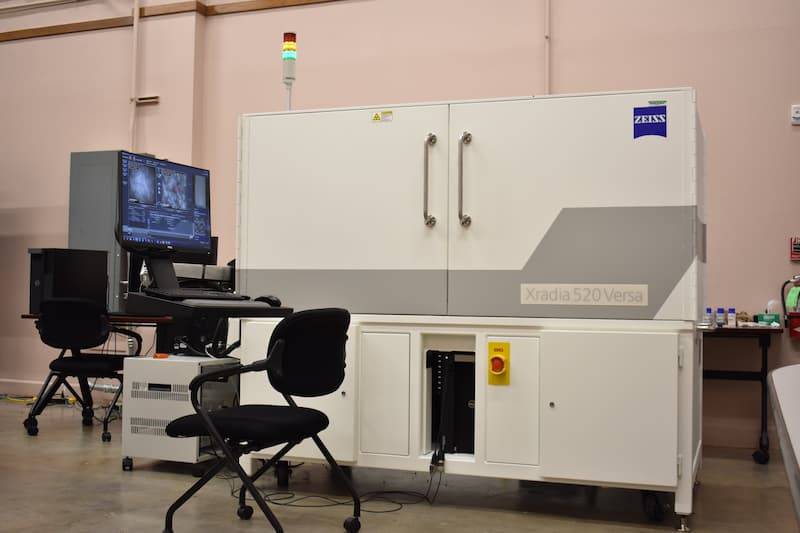

- Name: Xradia 520 Versa 3D X-ray Microscope
- Manufacturer: Zeiss
- Model Number: Xradia 520 Versa
- Location: AMMPI Annex 112
The ZEISS Xradia 520 Versa is a high-resolution, non-destructive 3D X-ray microscope
(XRM) that enables sub-micron imaging (down to 700 nm resolution) of internal structures
in materials, biological samples, and engineering components.
System Features
Resolution & Imaging Performance
- Submicron 3D imaging with industry-best contrast: achieve 0.7 µm spatial resolution and minimum voxel size of 70 nm for high-fidelity, non-destructive analysis across science and industry.
- Resolution at a Distance (RaaD) architecture: maintain fine resolution at larger working distances.
Advanced Optics & Detection
- Two-stage magnification: geometric magnification onto a scintillator, followed by optical objective magnification for superior contrast and detail retention versus basic projection micro-CT.
- Optional Flat Panel Extension (FPX): expand the detectable field and sample range, enabling efficient scans of larger parts while maintaining productive throughput.
Contrast Optimization & Material Discrimination
- Dual Scan Contrast Visualizer (DSCoVer): leverage differences in effective atomic number and density to reveal features that are indistinguishable in a single scan; perform side-by-side tuning and collect data for dual-energy analysis with ease.
- Automated Filter Changer (AFC): tune the X-ray spectrum for challenging samples or in situ workflows with 12 standard filters plus slots for custom filters; record filter choices in recipes for repeatable, automated runs.
Productivity & Throughput
- High-Aspect Ratio Tomography (HART): intelligently vary projection spacing on flat samples to achieve up to 2X higher throughput or improved image quality.
- Wide Field Mode (WFM): capture a ~2X wider lateral field of view and ~3X larger 3D volume versus standard mode, or use standard FOV to push resolution with more voxels in a single tomography.
- Vertical Stitching + WFM: image specimens that are both wider and taller than the standard FOV
Application Flexibility
- Versatile sample support for a wide range of sizes and materials—from semiconductor interconnects (e.g., defective TSVs) to composites, rocks/minerals, additively manufactured lattices, biomaterials, and more.
- Non-destructive 3D imaging enables iterative inspection, correlation with other modalities, and longitudinal studies without damaging specimens.
Safety & Protection
Radiation Safety
- Fully shielded X-ray enclosure designed to minimize stray radiation during operation.
- Interlock-protected access doors: beam automatically disables if the enclosure is opened.
- Emergency stop hardware for immediate system shutdown.
- Status indicators (visual/audible) for beam-on state and system readiness.
- Configurable exposure and energy limits within recipes to align with lab policies and sample sensitivity.
Operational Safeguards
- Automated filter handling (AFC) to avoid manual exposure during spectrum changes and reduce handling errors.
- Recipe-based automation that enforces validated scan parameters; embedded metadata records filter, energy, and exposure settings.
- Collision avoidance and soft-limit travel boundaries for samples, stages, and detectors.
Configurability & Accessories
Imaging & Detection
- Flat Panel Extension (FPX) (optional): expands field of view for larger samples while maintaining throughput.
- Automated Filter Changer (AFC): 12 standard + 12 custom filter slots for tailored X‑ray spectra.
- Objective & scintillator options: choose combinations optimized for resolution, contrast, or dose sensitivity.
Sample Handling & In Situ
- In situ stages (thermal, mechanical, environmental, electrochemical) for real‑time studies under controlled conditions.
- Specialized sample holders for wafers, PCBs, rocks/cores, fibers, pillars, biomaterials, and AM parts.
- Calibration standards for geometry, resolution, and contrast verification.
Software & Workflow
- DSCoVer dual‑energy workflows for material discrimination.
- HART templates for high‑aspect‑ratio samples.
- WFM & Vertical Stitching automation for large‑volume imaging.
- Recipe management & batch queuing for repeatable, unattended scans.
- Data export & integration with SEM/EDS, FIB‑SEM, and 3D analysis tools.
Facility & Integration
- Vibration isolation platforms and environmental/acoustic enclosures for stable, quiet operation.
- System indicators such as light towers and optional viewing windows.
- Networking & power options for data routing and remote workflows.
Service & Lifecycle
- Preventive maintenance programs and source life management.
- Applications training for DSCoVer, HART, WFM, and advanced contrast techniques.