 University of North Texas

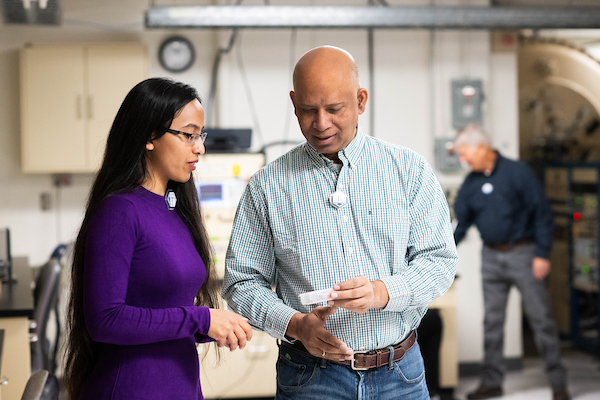
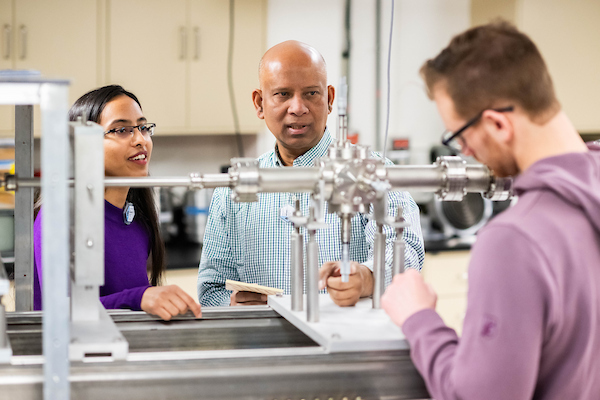
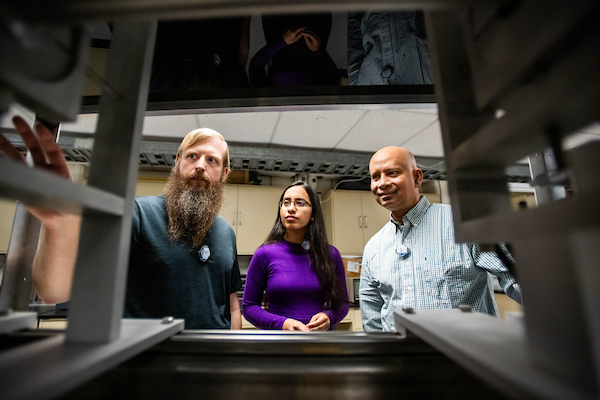
Led by UNT physics professor Bibhudutta Rout in the College of Science, a multidisciplinary research team has developed an in-situ radiation testing platform that allows researchers to observe electronic devices, including advanced solar cells, as they are exposed to conditions that mimic the environment in space.
Unlike conventional testing methods, which often require devices to be irradiated in one laboratory and transported elsewhere for analysis, this approach allows researchers to measure a device’s electrical performance during radiation exposure and monitor its recovery in real time without breaking the vacuum.
The distinction is important because radiation damage may not tell the whole story.
“Real-time testing delivers faster insights into device performance by eliminating the effects of sample transportation and minimizing the need for multiple samples.”
Effects of Radiation Exposure
In space, high-energy particles such as protons can damage the electronic components that satellites rely on, including photovoltaic cells that convert sunlight into electricity. Understanding how those devices respond to radiation is critical to determine how long they can operate reliably in orbit.
The research team’s latest work focuses on next generation of solar cell panels made from metal-halide perovskite that have attracted significant interest for space applications because of their high efficiency and lightweight construction.
The researchers exposed solar cells to proton beams designed to simulate radiation environments encountered in space. Rather than simply comparing the cells’ performance before and after irradiation, they monitored the devices while the exposure was taking place.
This approach revealed a surprising dynamic. Although radiation can cause significant initial performance losses, the solar cells can recover a substantial portion of their performance within minutes.
They also found that the extent of damage depends strongly on the energy of the incoming protons. Lower-energy protons can create concentrated atomic displacements that produce greater efficiency losses, while higher-energy protons distribute their effects more broadly and result in less persistent damage.
The findings suggest that the radiation resilience of perovskite solar cells may be greater than conventional testing methods have indicated.
“These results significantly affect the installation of satellites designed for longer durations,” Rout stated.
Mimicking Space
The research builds on more than two decades of work by Rout and his collaborators studying how energetic ions interact with materials at the atomic level.
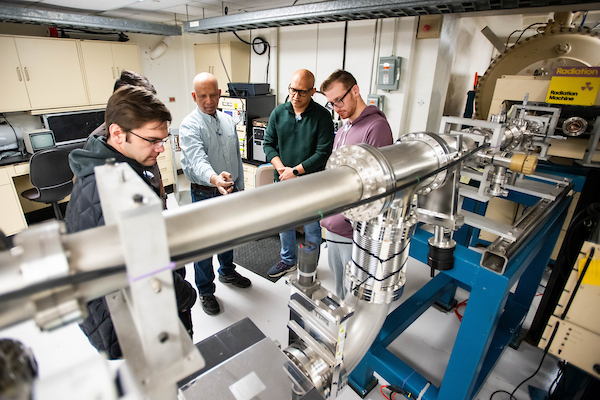
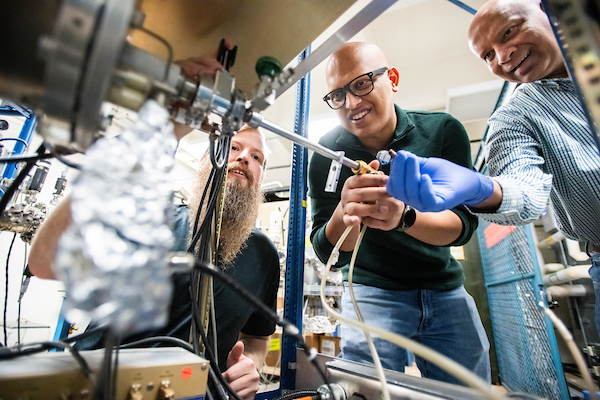
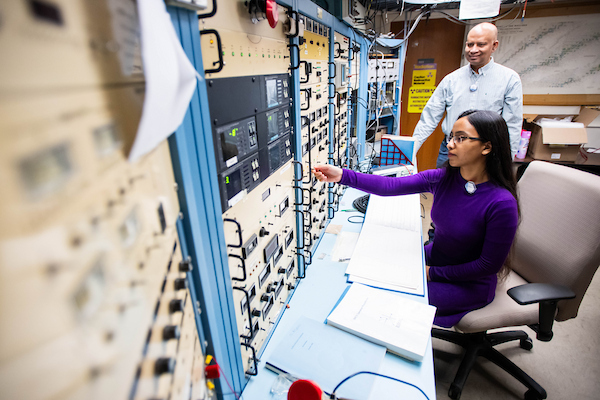
That expertise helped the team develop a specialized beamline at the university’s Ion Beam Laboratory that can expose devices to multiple environmental stressors at a single experimental station, including radiation, vacuum, heat and illumination.
The capability provides researchers with an opportunity to study how devices might behave in specific orbital environments without having to send experimental hardware into space.
“Our in-situ testing provides advanced performance data for devices, complementing actual space missions and reducing both project costs and timelines,” Rout described.
The platform is now operational and is being used by researchers from across the United States.
For the space industry, the implications could be significant. More accurate testing could help researchers and manufacturers identify materials and devices that can maintain performance longer in orbit, potentially contributing to lighter, more durable and lower-cost satellites.
Better understanding of radiation damage and recovery could also help engineers more accurately predict the end-of-life performance of satellite components, which remains an increasingly important consideration as satellite networks expand to support communications, navigation, security and other critical services.
Combining Physics, Engineering and Materials Science
The project brings together expertise from multiple institutions and disciplines.
Rout's team at UNT focuses on ion-solid interactions and radiation effects. Zhaoning Song at the University of Toledo contributes expertise in solar-cell fabrication, while Ian Sellers at the University at Buffalo specializes in optical spectroscopy and materials for space photovoltaics.
The broader collaboration includes researchers from national laboratories, NASA Glenn Research Center, Rochester Institute of Technology, the University of Michigan, Arizona State University, Oklahoma State University, the University of Oklahoma, the University of Dayton and other institutions. Portions of the research are supported by the U.S. Space Force's Space Strategic Technology Institute-3 program.
The complementary expertise allows the researchers to approach the problem from multiple perspectives, combining physics, chemistry, electrical and mechanical engineering, materials science and photovoltaic manufacturing.
Partners fabricate and supply advanced solar-cell devices for radiation testing, while other collaborators perform complementary characterization before and after irradiation.
The result is a research environment in which the same device can be studied from the atomic scale to the level of full photovoltaic performance.
Opportunity for Students
The research also serves as a training ground for UNT students, who have played hands-on roles in developing the testing capabilities and conducting experiments.
UNT doctoral student Mohin Sharma led much of the ion-solid interaction research and developed the in-situ electrical measurement capabilities as part of his Ph.D. dissertation.
“Mohin has developed the equipment and performed groundbreaking research towards the development of next-generation space solar cells,” Rout said.
Sharma's work has provided experience in advanced scientific instrumentation, radiation testing and semiconductor technologies. He has since joined Applied Materials in California, building on the expertise he developed through his research at UNT.
Other students and researchers have contributed to the project as well. Mritunjaya Parashar from the UNT ion beam group developed non-destructive methodology to monitor migration of elements across various layers of the device stack. Since then, Mritunjaya has spent the summer at Intel in Oregon working on the latest computer chips. Todd Byers, a postdoc at the UNT ion beam lab, contributed immensely to the durable and stable operation of the ion accelerator. He is currently working on the investigation of failure models of these solar cell devices. Haoran Chen, from the University of Toledo, prepared multiple rounds of high-efficiency perovskite solar cells for testing, while Brandon Durant, from the University of Buffalo, conducted photoluminescence measurements to help characterize the materials.
For Rout, student involvement is an important part of the project's impact.
The goal is not only to develop better technology for space, but also to prepare researchers
and engineers with the expertise needed to advance the semiconductor, microelectronics
and space industries.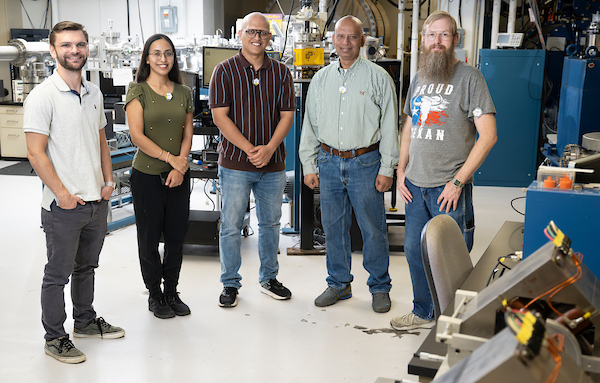
Building the Future of Space Power
The latest findings build on previous work investigating radiation effects in advanced photovoltaic materials and offer a more detailed picture of what happens to solar cells during and after radiation exposure.
The ability to observe both damage and recovery in real time could change how researchers evaluate the long-term durability of devices intended for space.
Rather than viewing radiation exposure as a single event followed by a delayed measurement, this approach captures the dynamic process as it is happening, providing researchers with information about how quickly damage occurs, how devices respond and how much performance can be recovered.
That information could ultimately help engineers design photovoltaic technologies specifically for the environments in which they will operate.
For Rout, the motivation is rooted in the fundamental question of how materials respond to the extreme conditions beyond Earth.
As satellite technology continues to expand, understanding how to make those systems more resilient will become increasingly important. By bringing radiation physics, advanced materials, photovoltaic engineering and real-time testing together, UNT researchers are helping build the scientific foundation for the next generation of space power.